
Starlink vs fiber in Kenya: Which is better for rural homes and businesses?
In Kenya’s remote and rural areas, reliable internet has always been a challenge. Traditional internet service providers have focused heavily on urban markets, leaving the countryside with either patchy mobile signals or no service at all. In recent years, fiber optic internet has made its way into some towns, but its reach is still very limited. On the other hand, Starlink—a satellite-based internet system—has begun offering high-speed connectivity even in places that fiber cannot touch. If you want to understand what Starlink is and how it works in Kenya, this breakdown explains the core technology and installation process for rural homes and institutions. The contrast between fiber and Starlink is not just about speed—it’s also about access, cost, flexibility, and long-term value.
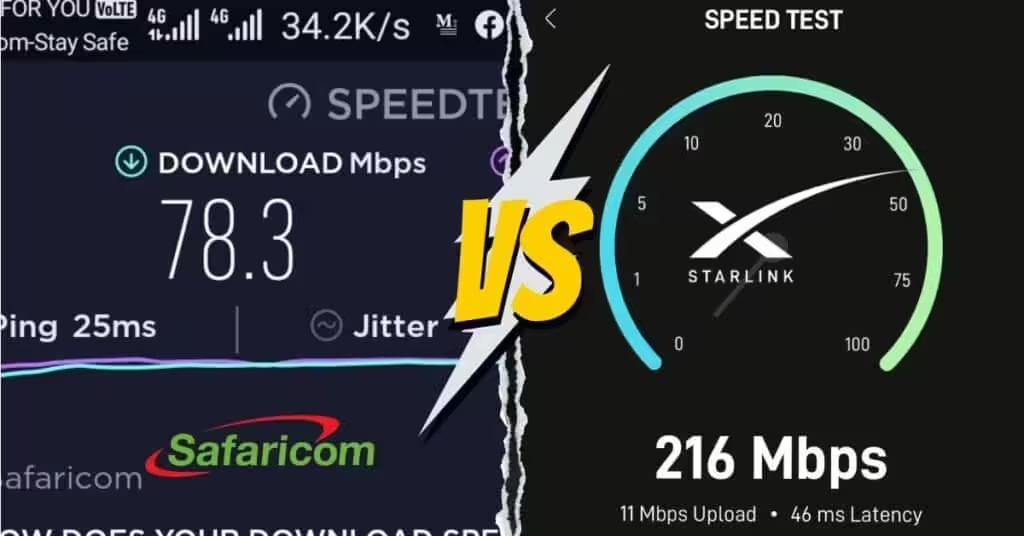
While fiber internet delivers excellent speeds where it’s available, the reality is that installing fiber cables requires major investment in underground infrastructure. This often involves trenching, permits, and months of coordination, especially in regions with rough terrain. Starlink, on the other hand, bypasses all that by using satellites in low Earth orbit to beam internet directly to a dish at your home. For a detailed look into how users are comparing performance in real time, you can explore actual performance tests here, especially in areas where both options are available for comparison. These tests show that Starlink’s speeds often match or exceed fiber in rural setups, while also being faster to deploy.
Fiber does offer outstanding reliability and very low latency in urban settings like Nairobi, Nakuru, and Kisumu. In areas where fiber has been deployed correctly, users can enjoy stable speeds of up to 250 Mbps or more, with latencies as low as 10ms to 20ms. However, these advantages only apply if you are within the fiber coverage zone. Outside major towns, even places just a few kilometers away may be left out. In contrast, Starlink can be installed in remote farms, lodges, schools, or homes that are completely off-grid. Users in Turkana, Embu, Bomet, and Kilifi have already set up Starlink kits and are reporting download speeds of 60 Mbps to 200 Mbps, with latency typically ranging between 30ms and 70ms, which is more than enough for video calls, remote work, and online schooling.
Another key difference is cost. Fiber installation is usually cheaper upfront because most providers subsidize the infrastructure to get customers onboard. Monthly packages range from KSh 2,500 to KSh 6,000 depending on the plan and provider. However, for users outside the network footprint, the cost of extending fiber to a rural area can run into tens of thousands of shillings, and providers are often unwilling to invest unless there’s a large customer base. Starlink has a higher initial cost—between KSh 89,000 and KSh 95,000 for the hardware—but setup can happen in less than a day, with no need for ground installations. Once active, the monthly subscription is about KSh 6,500, which is relatively stable across regions.
In terms of flexibility, Starlink is better suited for mobile or temporary setups. Farmers moving between multiple parcels of land, humanitarian workers operating in shifting locations, or businesses that relocate seasonally can all carry the dish and reinstall it with minimal effort. Fiber, once laid, cannot be moved without significant disruption and cost. This makes Starlink ideal for dynamic work environments like field research stations, wildlife conservancies, and mobile clinics that require reliable internet access regardless of where they are.
Power requirements also play a role in rural decision-making. Fiber routers need mains electricity, and without backup, connections drop during power outages. In contrast, Starlink is already being used in off-grid areas with solar power. The dish consumes around 60 to 100 watts, making it compatible with small solar inverter systems. Homes in Kericho, Kajiado, and Voi are powering their Starlink setups using existing solar kits, enabling 24/7 access even in regions where Kenya Power has no reach.
Support and maintenance differ widely between the two options. With fiber, service response times can vary depending on the provider and your location. Repairs to underground fiber cables can take days or even weeks in remote areas. Starlink, being a plug-and-play system with remote software updates, generally requires minimal support once installed. For users who need on-ground help, you can find local support services and Starlink setup professionals in various counties who specialize in aligning the dish and integrating solar systems for reliable use.
In community settings, both fiber and Starlink can serve multiple users, but again, Starlink’s advantage is its independence from infrastructure. In parts of Bungoma, Migori, and Samburu, single Starlink kits are being used to provide internet to several homes using mesh networks and signal extenders. Local cyber cafes are also adopting Starlink where fiber is unavailable, enabling them to serve students, job seekers, and mobile money agents without depending on weak mobile networks.
If your rural area already has fiber access, it can be a solid choice. The lower latency and unlimited bandwidth make it ideal for heavy usage like surveillance systems, online gaming, or shared networks with many users. But for most of Kenya’s rural and semi-urban households, Starlink wins for availability, speed of deployment, off-grid readiness, and mobility. It bridges the gap in places where fiber may never reach and gives users the chance to connect on their own terms.
As Kenya’s digital future expands, both fiber and Starlink will play roles—but for now, in the hills, valleys, and isolated plains, Starlink is delivering where fiber still cannot. Whether you’re running a farm, teaching online classes, or simply trying to stay connected, the better option for rural homes and businesses is increasingly looking like the sky-powered one.
Don\’t struggle with your essays alone. Trust our essay writing experts at Saseni.com
At Saseni.com, we have a team of expert essay writers ready to assist you with your writing needs. Our essay writing experts are highly qualified, experienced, and passionate about delivering top-quality essays. Whether you need help with a research paper, an argumentative essay, a persuasive essay, or any other type of academic writing, our experts are here to provide you with the assistance you need.
 Hire Essay Writer